
















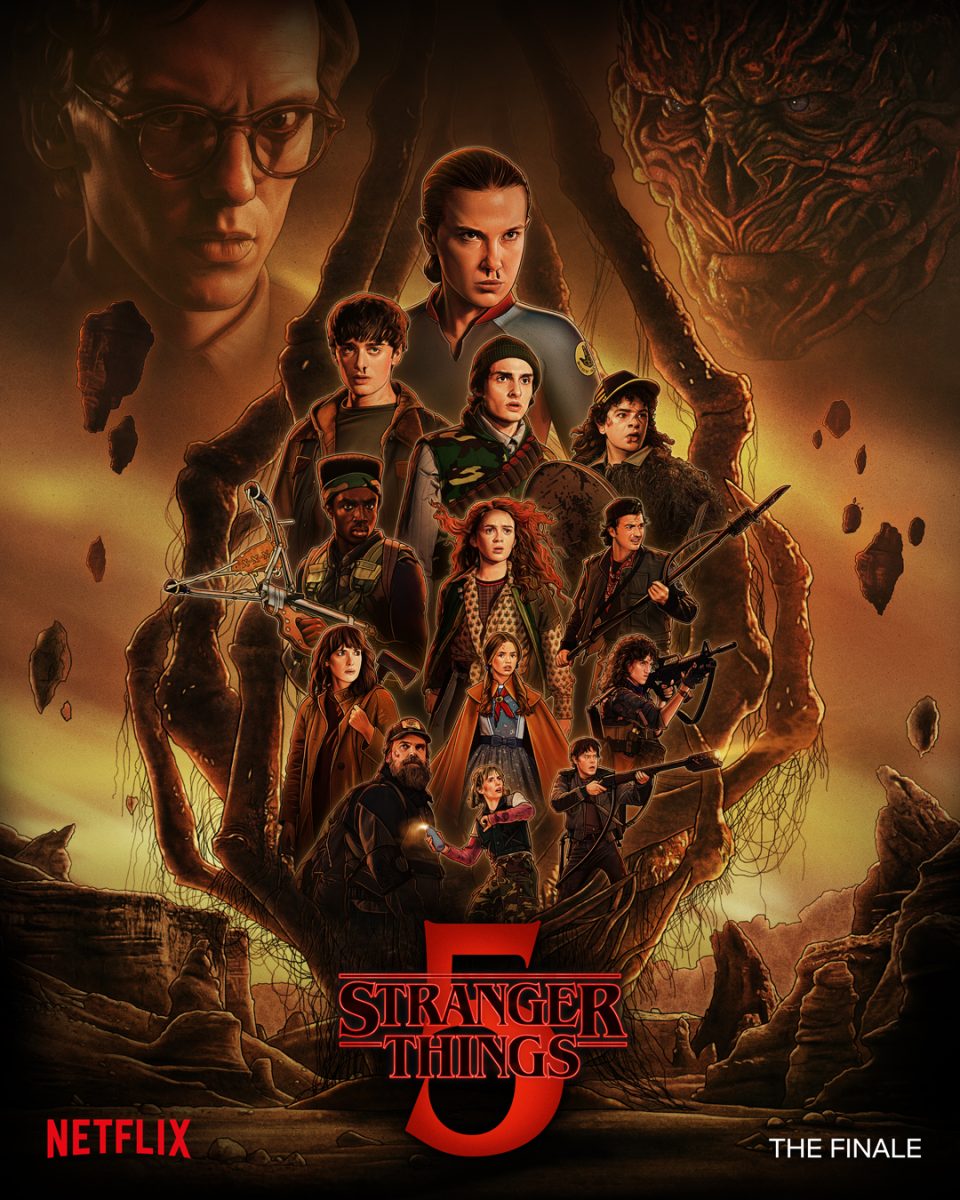
Stranger Things season 5 poster.
With four well-received seasons, audiences around the world were on the edge of their seats while waiting for the final season of Stranger Things. Enthusiastic fans were met with a detached final season that had little emotional depth, unsatisfying action, and a clear resolution. Fans were in such disbelief that an unannounced episode was even rumored to be released.
One of the reasons the first four seasons of Stranger Things were so popular was their emotional impact. In season five, scenes that would require deep viewer-actor emotional connection are often lackluster. Season five’s cast is overcrowded, keeping the audience detached, lily-padding between the little screen time each character gets.
None of the main cast truly died in season five. Even Eleven’s death was quickly undermined when characters speculated her survival. Previous seasons enforced the idea that no one was safe through characters like Barb, Bob, Billy, and Eddie. This format makes the series realistic and impactful. Without this concept, the final season feels shallow. Billy, in particular, was depicted beautifully, emotionally abundant, and realistic. Billy was flawed, but season four explored what caused his flaws. The writers find a way to humanize him and even create a feeling of sympathy between his childhood and his relationship with Max. The kind of layered writing that is missing in season five.
All the seasons prior had thrilling action that kept you on the edge of your seat. In the final season, however, the action feels rushed and weightless. The action in the climax of season five forgets about the series most iconic antagonists like the demogorgons, the demodogs, and the demobats. The series began as a mysterious, suspenseful sci-fi thriller, but as the series goes on, the suspense dwindles, and the action feels frivolous. The once stalking, invincible creatures become vulnerable and rational. The Mind Flayer, for example, started off as a mystery, an entity with disturbing powers, but then the monster took a recognizable, physical form that made it vulnerable and uninteresting. As the monsters’ weaknesses are discovered, they lose their impact. The demogorgons go from being unkillable monsters to common foot soldiers. The loss of mystery and suspense leads to a loss in creative depth.
After the finale, the Duffer brothers would do a multitude of interviews to clarify confusing scenes and plot holes. The Duffer Brothers touched on different character disappearances, like Suzie and Vickie. They also clarified confusing scenes such as Jonathan and Nancy’s breakup and Eleven’s “death.” The brothers’ vague explanations left fans believing there would be a secret final episode titled Conformity Gate. This theory was false, leaving fans disappointed with the ending the series got.